


I’m Darren Samuelsohn, and this is love, journalism.
Today’s edition is about the day a climate bill collapsed — and the toll of always being reachable, even mid-hike.
The first thing I think of when I think of Lindsey Graham is the worst Appalachian Trail hike I’ve ever been on.
It was a gorgeous April day in 2010. My wife and I were mushroom hunting, searching for fungi on paths only a few people know about — one of her most sacred rituals of the year, and for me, the tagalong, always a good time. We set off early that morning. It takes about an hour to climb, and then once you’re up there, you go foraging. We were most of the way up the mountain.
It was a weekend. I’d been working, working, working — a trade publication reporter for E&E News, covering climate. My BlackBerry stayed at home but I had one of the earliest 2010 iterations of the iPhone with me, the keypad a clumpety-clump-clump monster under your thumbs.
We were climbing up, up, up, when the breaking news hit. A phone call from a source telling me something huge was happening: Lindsey Graham was backing out of the climate negotiations.
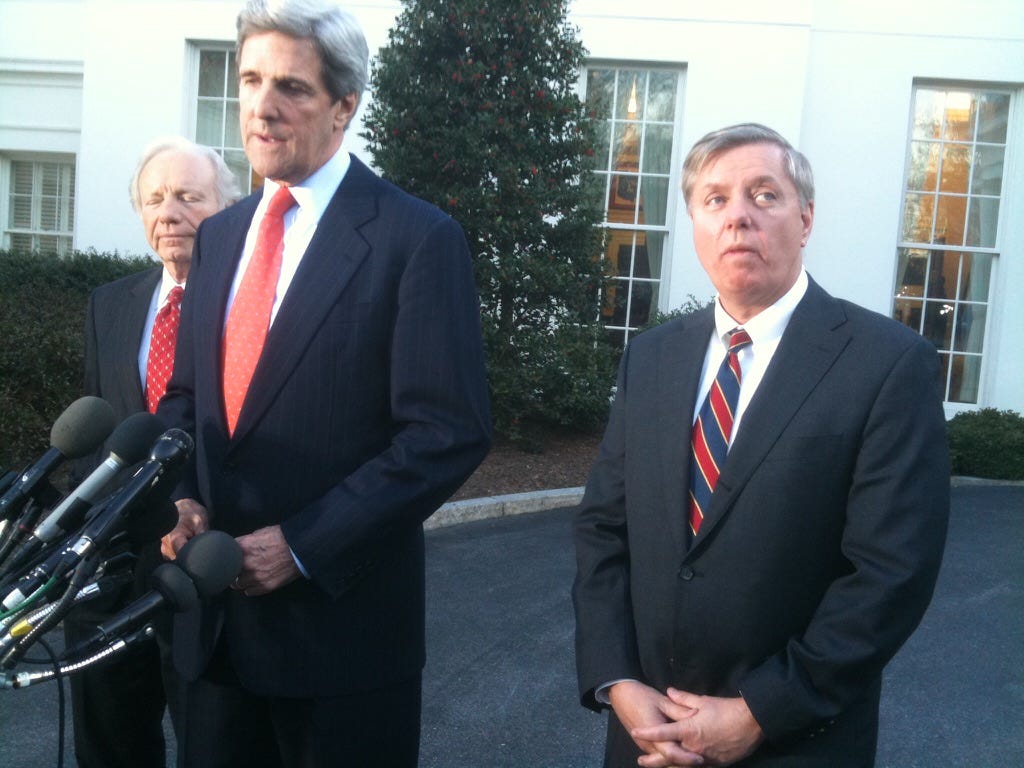
Why was that a big deal? Because Lindsey Graham was a vital player in the climate talks of 2010 — a Republican willing to deal at a moment when almost none were. His decision to walk away was basically the beginning of the end of the climate bill. He would argue otherwise. We’ll get to that.
Six months earlier, on October 10, 2009, Graham and John Kerry had sent a shockwave across the climate debate with a joint op-ed in The New York Times — “Yes We Can (Pass Climate Change Legislation)” — laying out a path forward on a bill President Barack Obama wanted, or at least seemed to want. Three days after it ran, I profiled Graham. He’d spent that summer testing his pitch at South Carolina town halls, and it wasn’t really a climate pitch at all. “You don’t have to be a true believer of drilling offshore or that climate change is real,” he told me. “You’ve just got to be willing to give and take.” He talked about trips to the North Pole and Norway and Alaska with his old friend John McCain. “I’ve been to every cold place that’s not as cold as it used to be,” he said.
McCain was really the one who had mattered here, and McCain was gone. He’d been the Senate’s climate champion for a decade, but after losing to Obama in 2008 and facing his own brutal primary back home in 2010, he’d gone silent on the issue entirely — left it to “two of his closest friends in Washington,” as I wrote at the time, Graham and Joe Lieberman. “He’s like a son to me,” McCain told me that October, happy to cede the spotlight. What that really meant was he wasn’t walking point on climate anymore, and the Republican who was — Graham — was carrying it almost alone.
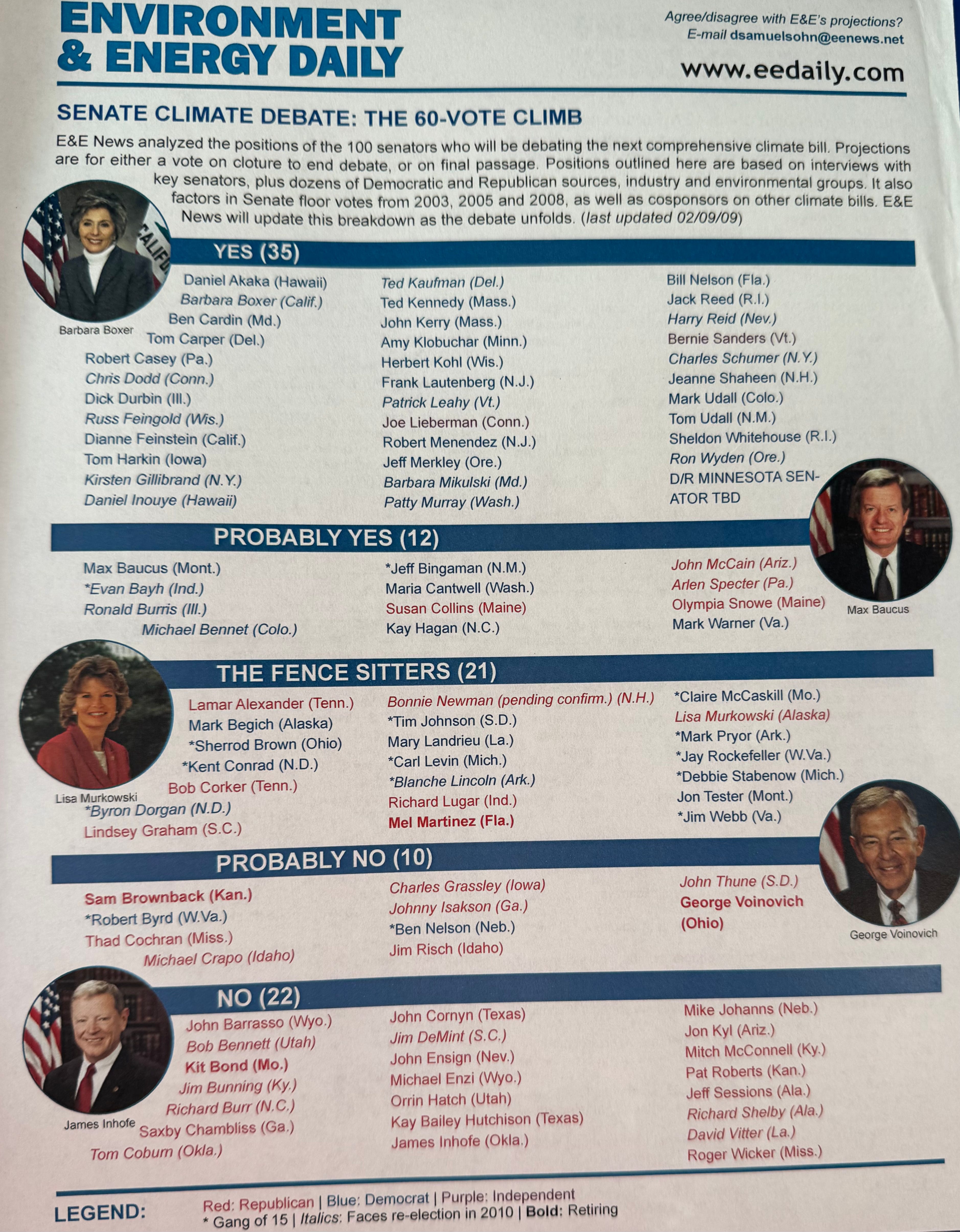
I was the vote counter, keeping tabs on where senators stood on climate for years by then, going back to the early aughts. Come April 2010, we were publishing my spreadsheet with regular updates, behind the paywall, that I walked around the Capitol marking up and handing to colleagues.
Then the oil spill happened. BP started spewing crude into the Gulf of Mexico, upending everything Graham had been trying to trade for — more offshore drilling — in the negotiations.
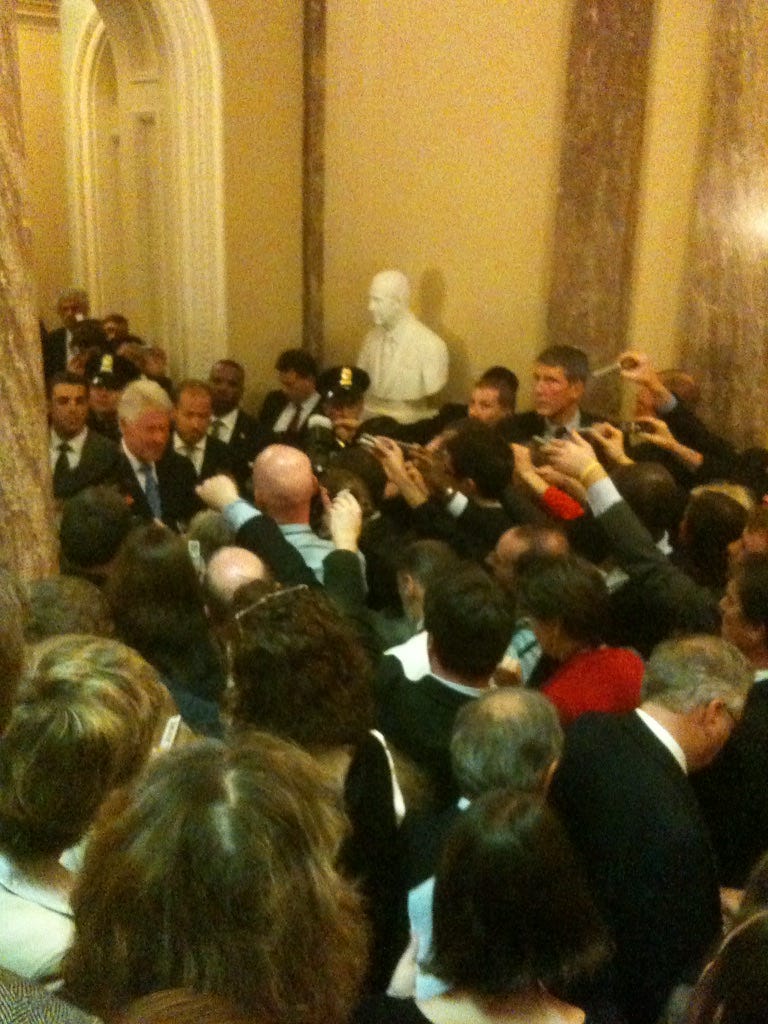
This is the place to explain how it works to be a trade reporter on Capitol Hill. You work inside a pack — mine was the climate pack, and I’d been in it since late 2000. You’re writing forecast story after forecast story, all of it behind a paywall, trying to tell people where a bill is going next, assuming it even has some momentum. You spend your days navigating the tunnels and hallways of the legislative complex searching for the lawmakers who know what is going on and are also game to tell you about it. For climate change, nobody in the Senate — which runs less on rules than the House — actually had that answer for climate change.
Then, right around Earth Day, Harry Reid made some kind of move on immigration. To this day I couldn’t tell you exactly what it was. I don’t think Reid’s own staff could have told you. And I know Joe Lieberman, observing the Sabbath, was not spending his Friday night bracing for Harry Reid to throw a grenade into the weekend.
But that’s what Lindsey Graham said happened. He started raging about immigration and insisting the bill was coming because Reid wanted to take it up. And then, on a Saturday, a tip came in via phone from a staffer for another senator while I was half way up a mountain.
I worked the phones while coming down the trail, trying to get confirmation. I remember tromping back down through the woods toward the car, and letting my wife keep going up without me — I felt awful about that, peeling off from her sacred morning to go write a story on a 2010 iPhone with no real keyboard, just clumpety-clump-clump under my thumbs, cutting and pasting sentences together while positioned sitting on a rock, not entirely sure our systems back then were built for breaking news like this.
My full dispatch ran that Monday morning under the headline “Senate sponsors scramble to save energy bill after lost weekend.” Graham had promised, I wrote, to leave President Obama and Senate Democrats standing at the altar — his own words for it were that Reid and the White House were running “nothing more than a cynical political ploy.” Reid tried to intervene by phone Saturday; the call went badly. Kerry and Lieberman scrapped a Monday press conference they’d had planned with business, religious, and military leaders standing behind them. “Am I supposed to write every bill for the whole country?” Graham had said back on Thursday, the day his concerns started boiling over.
The reaction came in fast and unsparing. Eileen Claussen of the Pew Center on Global Climate Change put it plainly when I asked what it meant if Graham really walked: “Then you’re totally out of it.” Tom Friedman went on CBS that Sunday and didn’t hold back either — Graham had gotten isolated on his own side and “freaked out a little bit here in the end,” he said, and the only winner was Beijing: “they are high-fiving each other.” Obama himself said nothing. He was on a brief weekend holiday in North Carolina, and it was Larry Summers and Carol Browner who spoke for the White House instead.
Weeks later, once he’d fully walked away, I asked Graham about it directly, and he didn’t dress it up. “I really don’t care what people think,” he told me. “I know what I’m capable of doing. I’m not going to do a deal for the hell of it. Why wouldn’t I reevaluate my position after the oil spill?” He was blunter still about the people on the other side of the table: “The problem is the people I did business with, climate change is a religion to them. This has been a business deal for me.” And he was clear-eyed about why Kerry and Lieberman had wanted him in the first place. “If they could have done it without me, they would have,” he said. “The only reason they were dealing with me, there was no one else to deal with. I saw that.”
In the end, Lindsey Graham was the guy who pulled the pin and tossed it. Lieberman groused about getting called back in on the Sabbath. And I got pulled off the Appalachian Trail — which that same season everyone was talking about for an entirely different reason, an entirely different South Carolina politician — to file a story from a mountainside on a phone that could barely keep up with my thumbs.
My wife kept going up. I never did catch up with her that morning.
GREAT story!!!!!!!